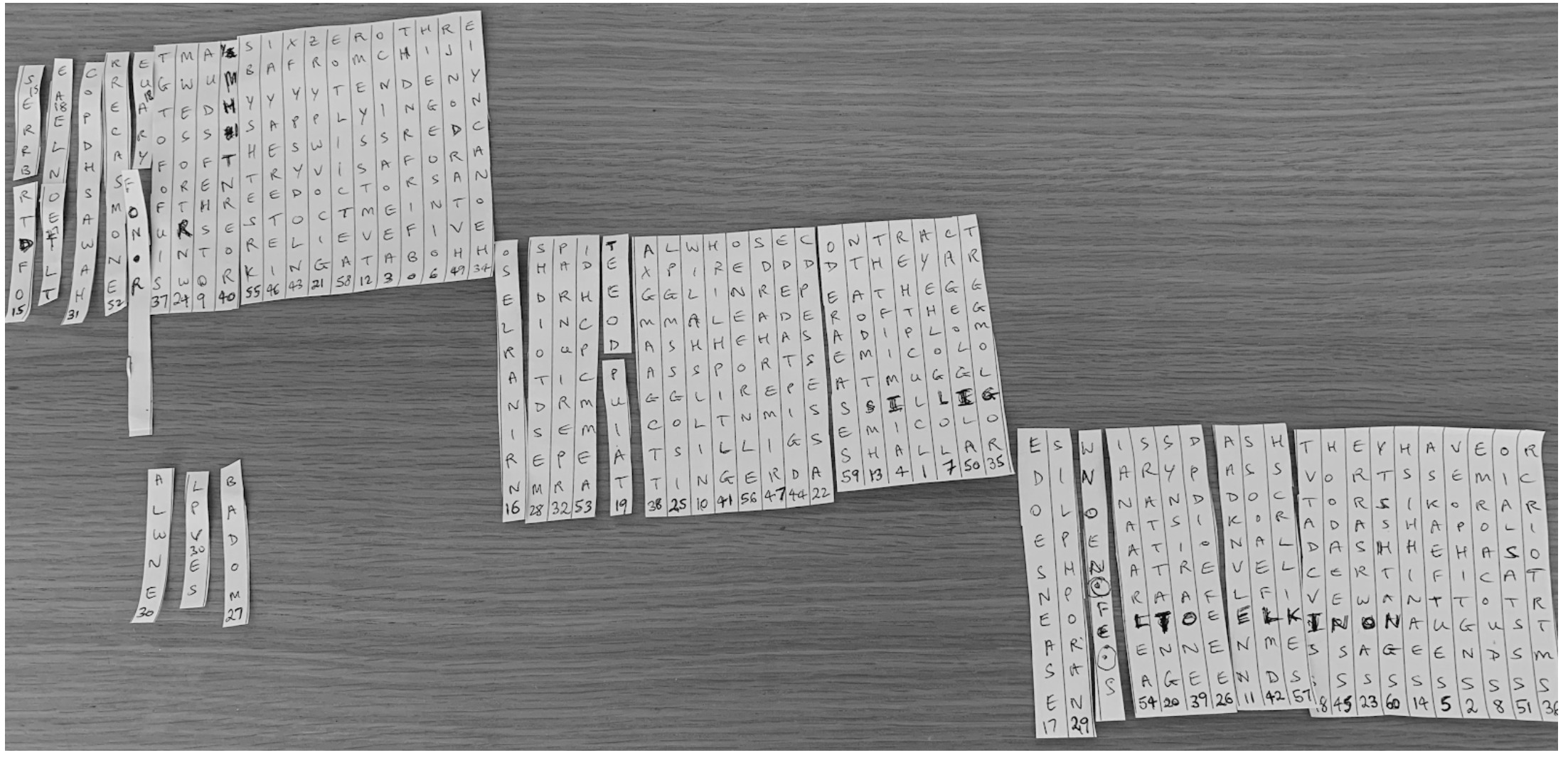
With George Lasry and Frode Weierud. The first published decryption of the transposition-enciphered telexes sent from Lisbon to Biafra in 1968 and 1969, during the Nigerian civil war. Four messages in five-figure groups are still unsolved.
With Sarah Lang and Megan Piorko. Solving an alchemical cipher in a seventeenth-century notebook shared by John Dee and his son Arthur Dee. Published at HistoCrypt 2022.
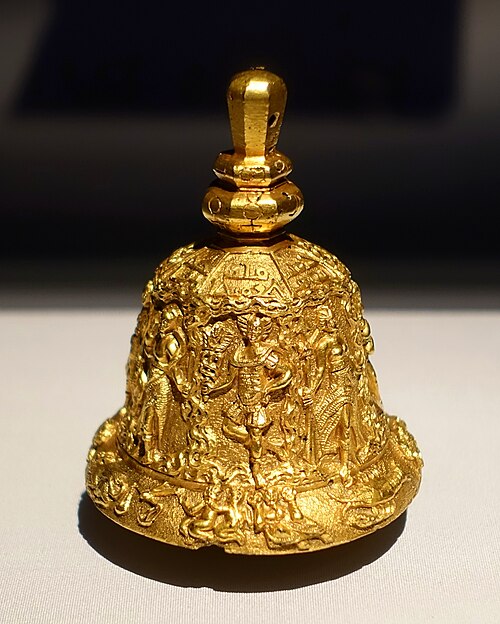
With Corinna Gannon and Sarah Lang. Investigating the unsolved 163-letter Greek cipher inscribed inside Emperor Rudolf II’s handbell of the seven planetary metals (Hans de Bull, c. 1600). Published at HistoCrypt 2023.
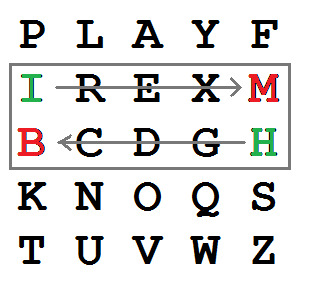
With Louie Helm. New world records for the shortest known Playfair cipher solutions, and the methods used to find them. Published at HistoCrypt 2025.
The IRA and Thouless ciphers (2019)
Two long-standing unsolved ciphers broken in the same month. The first was the last unsolved cryptogram from the 1920s Irish Republican Army messages published in Mahon and Gillogly’s Decoding the IRA (2008), a transposition cipher that had resisted Jim Gillogly himself. The second was the second of Robert Thouless’s 1948 “test of survival” ciphers, published so that he could prove his survival after death by communicating the key: a book cipher, solved by scanning the 37,000 English-language books of Project Gutenberg. Both solutions are described in The Conversation and the HistoCrypt 2020 paper; coverage included UQ News, the Brisbane Times, ABC radio and Klaus Schmeh’s Cipherbrain blog. The IRA solution has a named section in Dunin and Schmeh’s Codebreaking: A Practical Guide (No Starch Press, 2023).
Cryptanalysis of the fourth panel (K4) of Jim Sanborn’s Kryptos sculpture at CIA headquarters. K4’s plaintext surfaced in September 2025 through Sanborn’s working papers at the Smithsonian, but the encryption method behind it remains unexplained, so the cryptanalytic problem is still open. The buyer of Sanborn’s archive at the November 2025 auction, Paradigm, revealed itself in June 2026 and is keeping both plaintext and method sealed behind a hash-verification service. See the dedicated subdomain, the HistoCrypt 2021 paper and its test code.
Computational cryptanalysis tooling
Most of the cipher work uses programs I wrote in C: a command-line port of AZdecrypt’s transposition solvers (hill-climbing scored with n-gram statistics, that is, frequencies of n-letter sequences, taken from terabyte-sized text collections), an implementation of Reddy and Knight’s 2012 method for running-key ciphers, dictionary attacks on Playfair and Slidefair ciphers, and statistical tests for checking Kryptos K4 ideas. The code for the papers is on GitHub: Playfair, ArthurDee (the Dee cipher) and k4testing (Kryptos K4).
Energy and data science
Electricity-market modelling in PLEXOS
My current work at Energy Exemplar: developing PLEXOS (a commercial electricity-market simulation platform) models of the Western Australian, Northern Territory and National Electricity Market (NEM) power systems. This included leading a significant enhancement of the Western Australian market model (a Dynamic Frequency Control Model and ancillary-services trapezia with complex constraints), working closely with AEMO and private and government clients. It builds on earlier market modelling at ROAM Consulting (Australian and New Zealand markets) and forecasting review at AEMO; see the CV.
Forecasting and optimising the Monash Microgrid
Forecasting Prize winner (the most accurate forecasts in the competition) and second overall among 49 entrants in the IEEE-CIS Predict+Optimize Technical Challenge (2021). A combined forecasting and scheduling pipeline for the Monash University microgrid, published at AUPEC 2022. The source code and methodology show forecasting in R and constrained scheduling in Python with Gurobi. Full paper list under Publications.
Residential electricity under COVID-19, and home medical devices
A 2020 study in Energies examined changes in Queensland residential electricity demand during COVID-19 restrictions. A separate 2020 study in PLoS ONE developed an unsupervised method to identify which electricity phase supplies a home, using smart-meter data. This helps utilities plan outages and maintain reliable power for people who depend on home medical devices. Related work on on-demand batteries as a peer-to-peer service appeared at IEEE PES ISGT Asia in 2021.
Combinatorics
Critical sets, covering designs and domination: recent results
My PhD area, combinatorial structures such as Latin squares (grids in which every symbol appears once per row and column), remains active. Results from 2026: a proof that the smallest critical set (a set of entries that determines the square uniquely and is minimal with this property) over all Latin squares of order n has exactly ⌊n2/4⌋ entries, confirming a conjecture attributed to Nelder (1979) (preprint: arXiv:2610.18199); construction of a tight single-change covering design on 26 points with block size 6, resolving problem BCC19.1 from the British Combinatorial Conference problem lists (preprint: arXiv:2607.10978); explicit constructions, for every size, of dominating sets of the torus (the graph formed by the product of two equal cycles) with the number of vertices conjectured to be optimal (paper submitted; OEIS A094087; the matching lower bound is still open); an extension of the published census of critical sets in small Latin squares to order 7; and new records for the largest critical sets in Latin squares up to order 17, including the exact value lcs(7) = 25 (OEIS A063437). The search code is on GitHub as LatinSquares. Background on the earlier work is on the source-code and OEIS pages.
Transport analytics
Bike-share analytics across 40+ cities
Multi-year work with the University of Queensland and collaborators on weather, topography and gender in public bike-sharing schemes. Primary outputs in Transportation Research Part A, the Journal of Transport Geography, the Journal of Cycling and Micromobility Research and The Conversation.
E-scooter behaviour and road-rule compliance in Brisbane
With Scott Lieske and Richard Buning at the University of Queensland. Traffic cameras at eight Brisbane sites recorded micromobility and active-transport users over two years; machine learning plus manual coding turned that footage into more than 600,000 observations of helmet use, speed and where people chose to ride. Most riders followed the rules, and infrastructure made the difference: where there was a bike lane, and even more where the path was physically separated, riders kept off the footpath and within the speed limit. Published in Travel Behaviour and Society (2026), following an earlier study of how weather shapes e-scooter ridership in the Journal of Transport Geography (2022), a 2024 report for the Queensland Department of Transport and Main Roads (cited in the Queensland Parliament’s 2026 e-mobility inquiry report), and a plain-English write-up in Zag Daily.